How to Evaluate Rust Cheats Like a Private Menu Before You Buy One
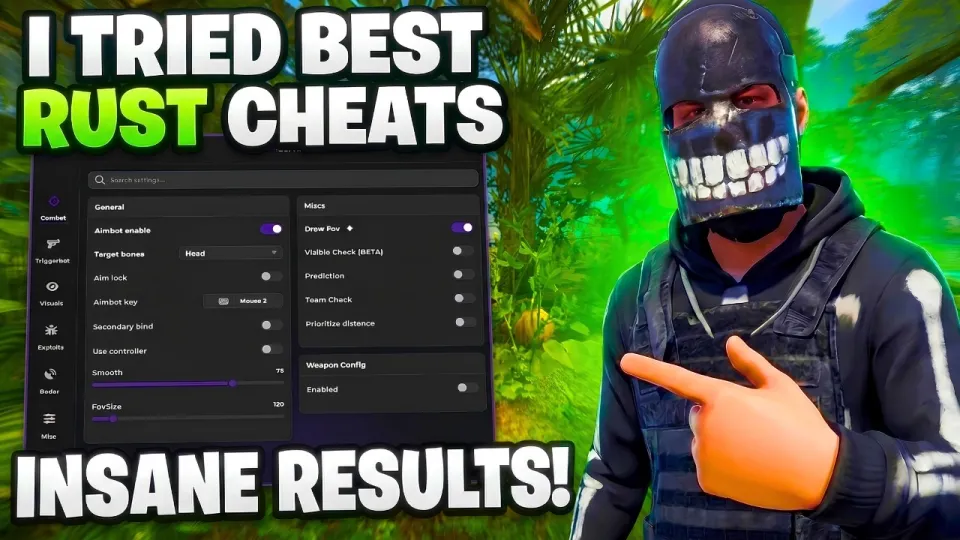
Video: I Secretly Used Rust Cheat To Dominate Everyone In The Server...(INSANE)
· based on the channel yqzkqrv
Rust cheats are third-party software overlays that add information and aim assistance to the game, and the most common way to judge one is to watch a full menu showcase before paying. The private cheat featured in yqzkqrv's breakdown, ZALIANT Private Rust Cheat, is presented through its interface, feature list, and in-game footage, which is exactly the material you need to compare it against other options.
What a Rust cheat menu actually contains
A Rust cheat menu is a configurable overlay split into tabs, and each tab controls a different category of advantage. In a typical private build the layout looks like this:
- Visuals / ESP — player boxes, skeletons, names, health bars, distance readouts, dropped-loot and stash markers, and sometimes a radar-style minimap.
- Aimbot — target selection (head, chest, nearest bone), field of view, smoothing, humanization delay, and per-weapon overrides for recoil control.
- Misc / World — no-recoil, no-spread, fast loot, instant craft, and movement tweaks.
- Settings — config saving, keybind assignment, and stream-proof mode that hides the overlay from capture software.
The showcase format matters here: a menu that is cleanly organized into these four groups is easier to tune down to something subtle, while a menu that dumps 80 toggles into one list usually pushes users toward obvious settings.
How to judge a Rust cheat showcase before buying
A useful showcase answers three questions: what the menu looks like, how the features behave in a live server, and what the vendor does after a game update. When you watch a breakdown like the one from yqzkqrv, check whether the footage shows the overlay running in real combat rather than a staged empty server — the difference between a wallhack that renders correctly through terrain and one that flickers at distance is only visible under load.
Pay attention to these concrete details:
- ESP draw distance. Anything under 300 meters is limited on a map where long-range fights are normal; most paid menus let you set 500–1000 m.
- Aimbot smoothing values. Low smoothing equals instant snapping, which is the single fastest way to get reported. Legit-style configs use high smoothing plus a small FOV, often 3–8 degrees.
- Recoil control toggles. Rust's spray patterns are learnable, so a cheat that only reduces recoil is harder to detect by eye than one that removes it entirely.
- Update cadence. Rust forces a wipe on the first Thursday of every month, and cheat builds almost always need a patch within 24–72 hours of that wipe.
Private vs public Rust cheats and what the price buys
Private Rust cheats are sold in limited quantities, and that scarcity is the product. A public or "cracked" build is shared with thousands of users, gets signature-detected quickly, and usually comes bundled with malware from reupload sites. A private license typically costs between roughly $10 and $40 per month, with lifetime keys running from about $100 to $200 depending on the vendor.
What you are paying for is not just the features but the maintenance: anti-cheat signature updates, config presets for different playstyles, and support channels such as a Discord server where buyers get patch announcements. The trade-off is that private software is still detectable — no vendor can honestly promise permanent safety, and anyone claiming otherwise is overselling.
Settings that keep a cheat from looking obvious
Configuration is where most cheaters get caught, not the software itself. A sensible starting point is to treat the menu as an information tool first and an aim tool second.
- Set ESP to show only players within 200–300 m and disable skeleton or name tags at long range.
- Use a small aimbot FOV (under 10 degrees) with high smoothing, and bind it to a hold key rather than always-on.
- Turn off instant-loot and fast-craft in populated areas; those actions produce animation glitches other players can see.
- Save a separate "safe" config for high-population servers and a looser one for low-pop practice.
- Re-test every setting after each monthly wipe, since feature behavior can shift with game patches.
Where to get the software and support links
The product page, the store front, and the community server are the three places tied to this particular cheat, and each serves a different purpose: the product page for the license and feature list, the store for other titles and account questions, and Discord for patch notes and config sharing.
- Product page: https://www.zaliantservices.com/products/rustprivate
- Store: https://www.zaliantservices.com
- Discord community: https://discord.gg/zaliant
The bottom line on Rust cheats
Rust cheats are a maintenance subscription, not a one-time purchase, and the quality of the post-wipe updates matters more than the length of the feature list. The ZALIANT private menu shown in yqzkqrv's video is a representative example of the current paid tier: a tabbed overlay with ESP, aimbot, and world options plus a config system, sold on a recurring license. Before buying anything, verify that the vendor publishes patch timing after Rust's monthly forced wipe and that support exists outside of a single checkout page. If the showcase looks good to you, the license is available at the ZALIANT Private Rust Cheat product page.
Key takeaways
- The ZALIANT Private Rust Cheat is sold at zaliantservices.com/products/rustprivate and is showcased by the channel yqzkqrv.
- A typical private Rust cheat menu bundles ESP, aimbot, and a configuration tab for per-weapon and per-key bindings.
- Rust wipes servers monthly on the first Thursday, so cheat builds usually need updates after each forced wipe.
- Cheat prices for Rust typically fall between roughly $10 for monthly keys and $150+ for lifetime licenses.
- ESP distance limits and aimbot smoothing are the two settings that most affect how visible a cheater looks to other players.
Source: I Secretly Used Rust Cheat To Dominate Everyone In The Server...(INSANE) · Markdown version
Questions & answers
Are Rust cheats detectable?
Yes. Rust uses Easy Anti-Cheat plus server-side and manual review, and no paid or private menu can guarantee permanent safety. Private cheats tend to last longer because they are distributed to fewer users and patched after signature updates, but bans still happen, especially after the monthly forced wipe when detection code is refreshed.
How much do Rust cheats usually cost?
Monthly keys generally run from about $10 to $40, while lifetime licenses typically sit between $100 and $200. The price mostly reflects update frequency and support rather than the number of features, so a cheaper menu with fast post-wipe patches is often better value than an expensive one that goes down for a week.
What features are standard in a Rust cheat menu?
Most menus include ESP for players and loot, an aimbot with FOV and smoothing controls, and misc options such as recoil reduction and fast loot. Higher-tier builds add stream-proof mode, per-weapon configs, and a radar. The settings tab, where you can save and switch configs, is often the most important part of the menu.
When do Rust cheat updates come out?
Rust forces a wipe on the first Thursday of each month, and cheat developers usually ship compatibility patches within one to three days of that wipe. If a vendor's Discord shows no patch announcement within that window, expect the software to be unusable or risky on live servers until it is updated.